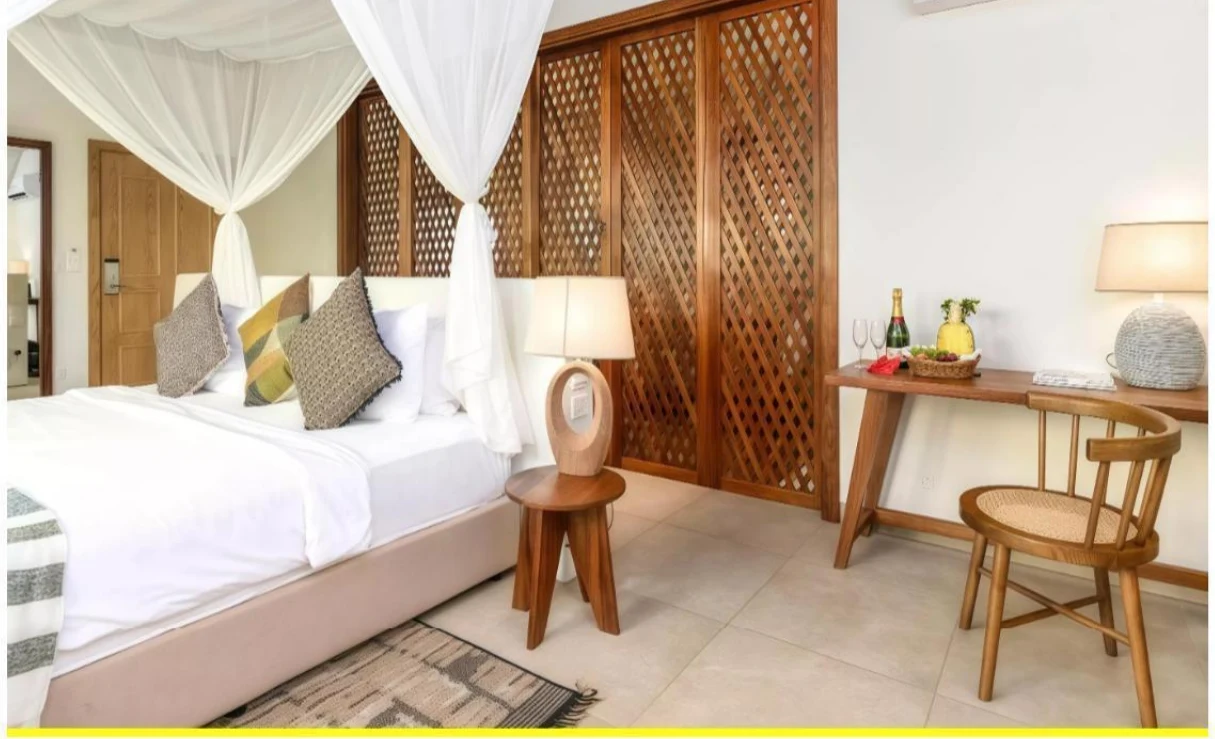
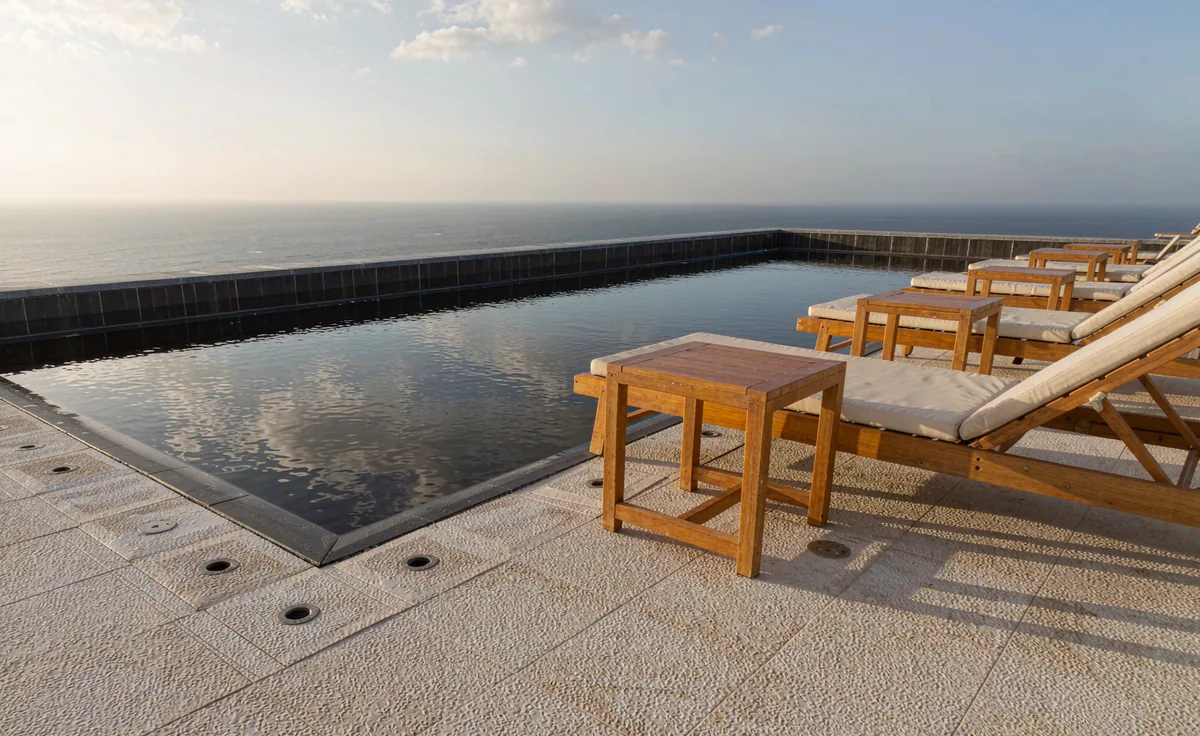
A lounger that creaks in its third season, a table rusting at the base, a parasol tipping over at the first gust: on a pool deck these incidents are not settled by a claim, they are settled by early replacement. Hotel terrace furniture is therefore handled as a technical package, with four decisions locked before the tender: the material family, the fixing type, the connection to the ground and the coherence across terrace, pool deck and garden. What follows does not rank materials by prestige: it ranks them by what they actually withstand over some ten years of operation, salt, chlorine, UV and daily handling included.
Which materials best resist salt, chlorine and UV on a hotel terrace?
No material resists everything: teak and black locust hold up to salt water but suffer from neglected maintenance, aluminium tolerates chlorine and washing but concentrates the risk in its fixings, and woven resin resists UV only if its HDPE is stabilised and its frame remains aluminium. The choice between these four material families is therefore made by elimination according to real exposure, not by a hierarchy of prestige. Teak (Tectona grandis) owes its reputation to two wood compounds: tectoquinone, which limits insect attack, and a silica content that seals the surface against water while wearing out tools. On a hotel terrace this translates into a service life generally between ten and fifteen years without fungicide, provided the timber comes from a managed plantation and is properly dried before machining. Teak dried too fast moves, opens its joints and turns white in patches from the first season. The moisture content of the batch is checked before machining, generally 8 to 12% depending on origin, and batches above the upper limit are refused, even when the price per cubic metre is attractive. A chain-of-custody certification such as FSC does not cover this point: it documents origin, not drying. Black locust (Robinia pseudoacacia), sold as false acacia, grows in Central Europe. Its hardness exceeds teak and its natural durability places it in use class 4 without treatment, allowing direct ground contact. It greys faster and takes on a silvery tone close to aged teak, with no oiling. Two operating reservations matter: weight, which complicates end-of-season handling, and checking, frequent on insufficiently stabilised solid sections. Aluminium 6060 or 6063, T6 treated then powder-coated, is the easiest material to operate on a pool deck: it does not rust, does not swell, accepts hosing and diluted chlorine, and stacks without splitting. Two points are checked at order: coating thickness, generally 60 to 80 µm for class 2, and the treatment of cut edges, because a bare cut becomes the entry point for filiform corrosion, especially in the coastal band. Surface temperature rises fast in the sun; on seating, weaving or textile remains necessary. Woven resin means HDPE yarns woven around a core, and quality depends not on the pattern but on three parameters: UV stabilisation of the HDPE, an aluminium core, and solution-dyed yarn. In a tender, the only useful question remains: can the supplier produce the test report of the delivered batch, not the one from the trade-show collection? In summary: teak — very good by the sea if drying is controlled, optional oiling and gentle cleaning, 10 to 15 years depending on exposure, main limitation price and batch variability; black locust — very good, use class 4, no oiling, 12 to 18 years observed, main limitations weight and checking; powder-coated aluminium — good, cut edges to protect, washing with water and neutral soap, 10 to 15 years depending on the finish, main limitation corrosion at the fixings; woven resin — good if HDPE is stabilised, hose cleaning without solvent, 5 to 9 years on the most exposed pieces, main limitation weaving replacement.
Teak, black locust, aluminium or woven resin: what is the ten-year operating cost?
Over ten years, the purchase price is only part of the spend: teak costs more upfront and little to maintain if the silvered look is accepted, aluminium costs less and needs almost nothing, woven resin costs the least but is replaced earlier on the most exposed pieces. The right indicator is therefore not the unit price but the full operating cost over the seasons actually served. Three cost items weigh heavily and disappear from price comparisons. The first is storage labour: a 12–18 kg solid-wood lounger takes two people, a 6–9 kg aluminium lounger takes one, and this difference becomes staff hours every evening of high season. The second is parasol mast breakage, often costlier than seating breakage, because a fallen parasol takes the neighbouring table with it. The third is replacement logistics: a part available in 45 to 60 days gets replaced, a part available in six months condemns the area. On a project in Doha (Qatar), a batch of woven-resin tables bought for their price lasted three seasons on the pool deck, then were replaced by aluminium tops and better-quality woven seating: the initial saving had been absorbed by two replacement campaigns and the time spent handling complaints. The same pattern returns in Muscat (Oman) on pieces left outside all year without shade. There is nonetheless a cost argument that holds: at equal specification, direct factory supply often sits 30 to 50% below a European brand quotation, provided documented quality control and a 45 to 60 day production lead time are accepted. The comparison only makes sense if the specification is identical on both sides: same profile thickness, same coating class, same assembly quality and same timber moisture control. On an indicative ten-year model, acquisition accounts for roughly 55–65% of total cost in teak, 50–60% in black locust, 60–70% in aluminium and 45–55% in woven resin; maintenance and cleaning 15–20% in teak and resin, 10–15% in black locust and aluminium; part replacement 10–15% for the first three families and 20–30% for resin; storage labour 5–10% in teak and aluminium, 10–15% in black locust and resin. This model is recalculated with the project's volumes and hourly rates, since the ranges vary with exposure and season length. The tiering logic described for hotel guestroom furniture applies outdoors too, with one extra criterion: the most exposed piece is not the one receiving the most guests, it is the one that stays in sun and spray all year.
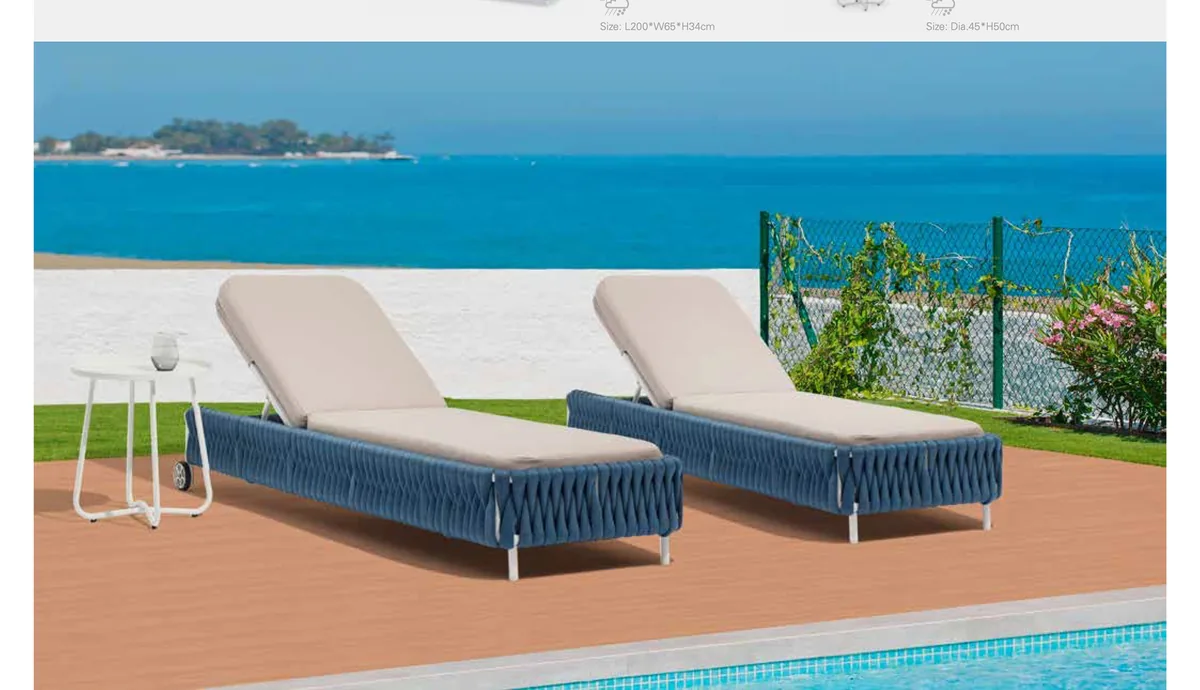
Which fixings to choose per substrate: concrete slab, joist, gravel or lawn?
Fixings are chosen per substrate, not per habit: a concrete slab accepts a mechanical or chemical anchor in A4 stainless steel, a composite joist requires a countersunk A4 stainless screw with pre-drilling, gravel calls for a ballasted base without anchoring, and lawn a stake or a load-spreading plate. Each substrate has its own load-path logic, and these fixings rarely transfer from one substrate to another. On concrete, the critical point is not the anchor but the edge distance: an anchor set too close to a slab edge cracks the concrete before it holds, and the crack becomes a water path. A dimensioned anchoring plan is requested, with rebar positions where drawings exist, and a four-point base plate is preferred over a central foot on wind-exposed terrace tables. Right next to the pool, chemical anchoring remains possible but becomes delicate: resin dislikes a damp substrate and chlorine attacks some formulations; a ballasted, removable base plate avoids the problem. On composite or timber joists, countersunk A4 stainless screws with pre-drilling are the baseline; composite moves with temperature and a screw set without pre-drilling opens a crack that lengthens over one summer. Hidden clip fixings work on decking boards, not on load-bearing structures. On a timber deck, the washer matters as much as the screw: a washer too small marks the wood, a non-isolated stainless washer creates a galvanic couple with the aluminium of the base. On gravel and sand, no point anchoring is reliable: the solution is a heavy base, precast concrete or a fillable tray, whose mass is calculated from the wind load of the piece. On lawn, aim for a through stake or a buried spreading plate; with automatic irrigation the stake rises and the piece tips. Finally, on pool coping, drilling is almost always a bad idea: coping is often glued and drilling opens a water path under the tiling. A ballasted base set on the coping, with a soft glide, solves the need without touching the waterproofing. Summarised per substrate: concrete slab — 4-point base plate and A4 stainless anchor, avoid an anchor near the edge, check edge distance with a dimensioned plan; composite joist — A4 stainless screw with pre-drilling, avoid zinc-plated wood screws, check for crack initiation; gravel and sand — ballasted base or fillable tray, avoid a stake without a mass, check mass and wind load; lawn — through stake or spreading plate, avoid a simply set foot, check hold after watering; pool coping — ballasted base and soft glide, avoid drilling the coping, check waterproofing and level.
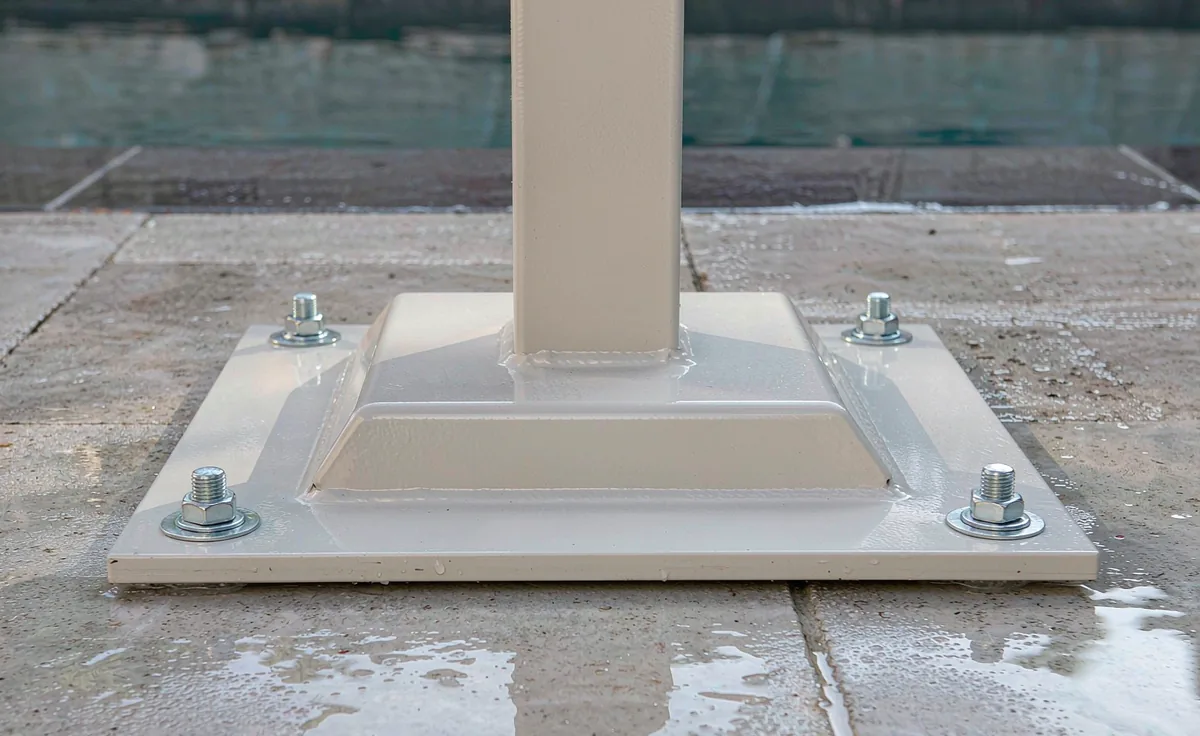
How to choose feet and glides for wind, standing water and cleaning?
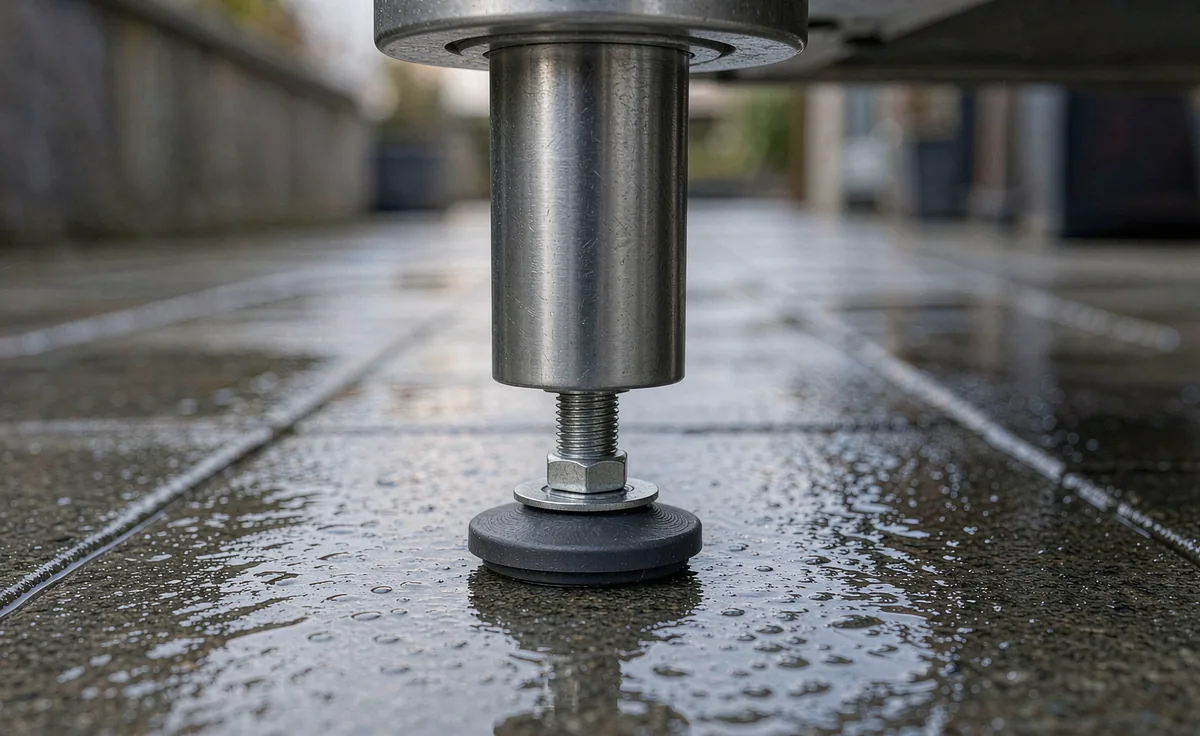
Feet transfer three things to the ground: weight, lateral wind load, and the water running down the leg; choosing glides therefore means trading off slip, grip and drainage, with levelling adjusters compensating the slopes of a pool deck. A glide chosen to protect tiling can, at the same time, make the furniture unstable on a wet deck. The first trap is the felt glide, common on indoor pieces and disastrous outside: it absorbs water, swells, detaches and leaves a ring on stone. The second is the black filled-rubber glide, which migrates on light decks and leaves marks that are hard to remove. Drainage matters as much as material: an open-bottom tubular leg draws in water by capillarity, keeps it in the profile and releases it as a rust stain at the weld. Legs are delivered with closed end caps and drainage holes drilled at the lowest point, and this detail is verified on the assembly sheet rather than on the photo. On a project in Nice (France), a batch of tables delivered with simply pushed-in end caps saw, after one winter, trapped water burst the powder coating at the base; replacing the end caps cost less than reworking the frames. Wind is handled at the base, not the canopy: a 3 m parasol on a base of about twenty kilos lies down at the first storm, whatever the fabric quality. Water-fillable bases are practical in summer and awkward in winter, when freezing water splits the tray; sand weighs more per volume but travels badly. For stackable seating, a strap or shrink film over the stack prevents the sail effect. Finally, removable covers with quick-drain foam dry in about an hour, solid-foam cushions stay damp for two days or more and smell of chlorine. For choice by surface: PTFE or light polyamide glide on slab, stone and tiling — slides without marking but grips poorly on wet ground; studded EPDM glide on composite and timber — good grip but may mark light floors; filled polypropylene glide on concrete and compacted gravel — resistant and economical but crushes under heavy load; ballasted base on gravel and coping — stable and removable but bulky and heavy in logistics.
Which specifications and tests to require in an outdoor furniture tender?
An outdoor tender is judged on five documents: the reports of EN 581-1, EN 581-2 and EN 581-3 tests, the salt-spray and coating-adhesion test records, the assembly sheet with the anchoring plan, the spare-parts list and the approved sample. Without these five documents, the compared price compares nothing, and the best offer on paper becomes the costliest in use. The EN 581 series covers outdoor furniture for domestic, communal and camping use: part 1 covers general safety requirements, part 2 seats, part 3 tables. The corresponding test methods, notably EN 1728 for seating and EN 1022 for stability, say how loads are applied, how tipping is tested and how measurements are taken. A serious supplier cites them with the laboratory and the report date; a supplier who answers 'compliant with European standards' without a report number has no report. Powder coating is documented by two tests: salt spray per ISO 9227, with a duration depending on the target class, and adhesion per ISO 2409, with an expected class of 1 or better. For woven pieces, request the UV ageing report per ISO 4892-3 and the HDPE composition. For timber, request the species, origin, moisture content before machining and, where applicable, the chain-of-custody certificate. Three clauses deserve to be written black on white in the contract: spare-parts availability duration, expressed in years and not 'subject to stock'; the warranty structure, split between frame, finish and weaving, because a single five-year warranty often hides a finish exclusion; the sample approval procedure, with a validation lead time and a clear rule on colour variation between prototype and series. Manufacturing control is also verified: a supplier audit per ISO 9001 documents a system, not a batch; ask in addition for the batch control plan, coating-thickness records and treatment-bath traceability. The thresholds to request, item by item: general safety EN 581-1, dated report with identified laboratory; outdoor seating EN 581-2, compliant load and stability; outdoor tables EN 581-3, stability test included; salt spray ISO 9227, duration per class and report of the delivered batch; coating adhesion ISO 2409, class 1 or better; UV ageing ISO 4892-3, report on the delivered HDPE.
How to build a coherent package across terrace, pool deck and garden?
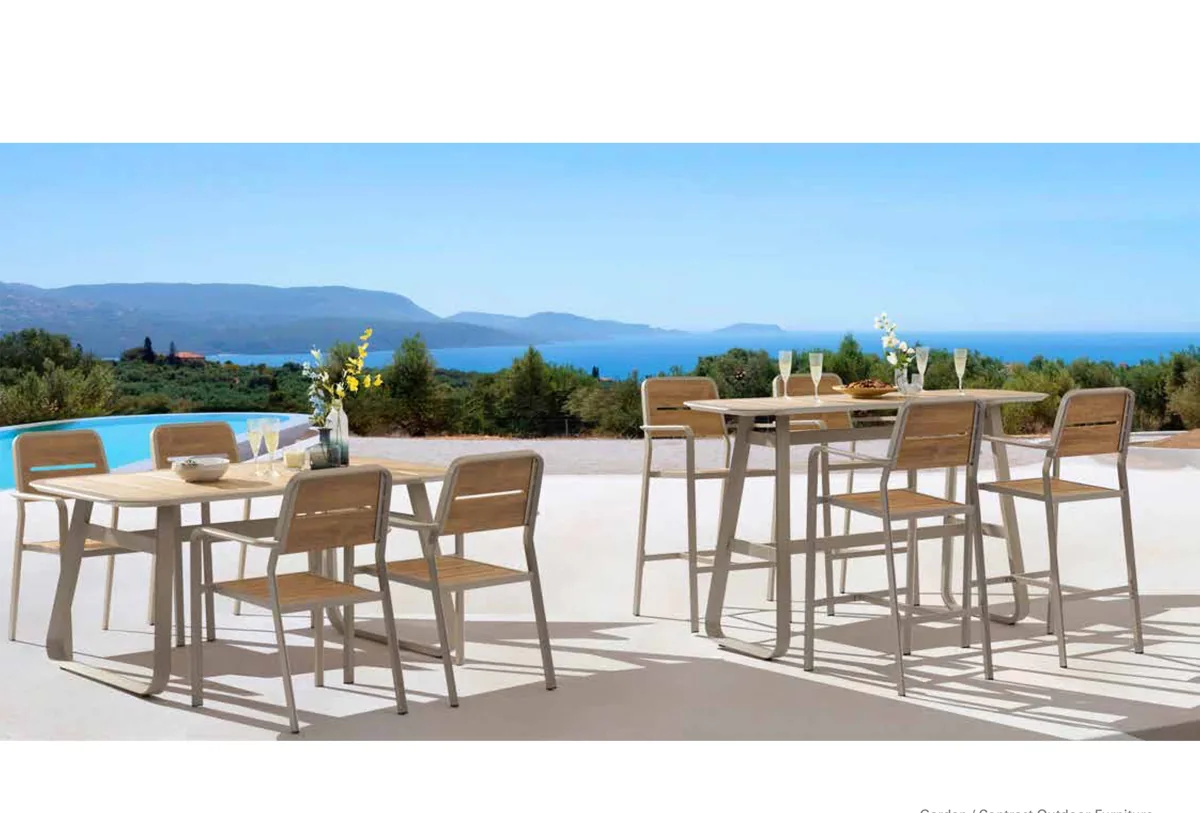
A coherent terrace and pool furniture package is built by zone: the covered terrace favours comfort and the warmth of timber, the pool deck favours aluminium and resin for lightness and fast drying, the garden favours robustness and ground anchoring. Coherence does not come from a single material applied everywhere; it comes from a palette, a vocabulary of shapes and a finish level held from one zone to the next. Piece counts follow operations, not the architect's plan: the ratio sits rather between 0.6 and 1.2 loungers per room depending on the number of pools and the clientele, and a restaurant terrace needs a cover count equal to seated capacity plus a 10–15% reserve for breakage and replacement. These ratios are checked with the operator before the quantities are frozen, because they also determine the size of the storage area. Storage is the poor relation of outdoor packages: a stack of ten loungers occupies about 1.5–2.5 m² of floor, provided the geometry allows it; a badly designed folding table takes more room than a fixed one. In an urban hotel, storage is often an unventilated technical room where cushions stay damp; breathable covers and low-level ventilation cost less than replacing the foam after two years. The finish palette is locked early: two different suppliers on the same pool deck produce two shades of grey because of the powder batch, and the difference shows in full sun. If the package is phased, either order all the powder at once or accept a written colour tolerance. The hotel furniture checklist helps not to forget the accessory pieces — ashtrays, beach trolleys, poolside racks — which carry little value and many complaints. Finally, the outdoor package must plan its own renewal: a pool-deck chair is often replaced by two or three units each season, not thirty. Keeping the reference, shade and technical sheet of the batch allows unit orders three years later. By zone: covered terrace — armchairs and low tables, comfort and warm touch, teak or black locust; pool deck — loungers, tables and parasols, drying, weight and washing, aluminium and resin; garden — benches and dining tables, anchoring and robustness, black locust or aluminium; private beach — low loungers and trolleys, sand, wind and storage, aluminium or light resin. Hongye Furniture Group has supported hotel projects since 1996 with outdoor ranges produced under the same control requirements as indoor furniture; for a terrace and pool package, the FF&E team works from plans, quantities and anchoring constraints, then provides assembly sheets, test reports and samples before launch, with sample confirmation following the documented procedure that locks shade, material and finish before the series.
Frequently asked questions
Which timber should be chosen for a hotel lounger by the sea?
Teak remains the safest choice for seating in direct contact with saline air, provided a properly dried batch with traceable origin is required. Black locust offers higher hardness and needs no oiling, but its weight complicates daily storage. On a lounger handled twice a day, this criterion often weighs more than service life.
Does aluminium get too hot in the sun on a pool deck?
An unprotected aluminium profile reaches a high surface temperature in full sun, which makes seating uncomfortable. The solution is not to change material but to cover the contact zones: weaving, technical textile or a composite top on the armrests. Frames and legs stay in aluminium, where heat causes no usability problem.
Should pool coping be drilled to fix a parasol?
In most cases, no. Coping is often glued onto a shell and drilling opens a water path under the tiling that is hard to repair. A ballasted base set on the coping, with a soft glide and a mass calculated from the parasol's wind load, covers the need without touching the waterproofing. Drilling is only justified on a documented structural slab.
Which fasteners should be used on an aluminium frame by the sea?
A4 stainless steel, formerly 316, with isolation between the screw and the aluminium. A2 stainless is enough in urban atmospheres but holds up less well against chlorides. The isolating washer or nylon bushing prevents the galvanic couple that perforates the profile around the hole. A zinc-plated screw, however treated, remains a stopgap, not a project specification.
How long does hotel terrace furniture last?
Service life depends more on exposure and maintenance than on the material alone. Five to fifteen years is generally observed for a properly specified package, with gaps linked to material and exposure: maintained teak lasts longer, woven resin in full southern sun is replaced earlier. The pieces closest to the pool are always affected first.
Can the furniture be left outside all year?
Yes for the structure, with reservations. Powder-coated aluminium and black locust cope with winter, provided water does not stand in the legs and the glides are suitable. Cushions, straps and weavings degrade faster if left exposed. On a windy site, light pieces are strapped or stored, even in summer.
What lead time should be planned for a complete outdoor package?
Count generally 45 to 60 days of production after validation of samples and anchoring plans, to which transport and customs clearance are added. Sample validation itself takes one to two weeks depending on the number of finishes. On a phased project, ordering spare parts with the first delivery avoids a shortage in high season.